
Instagram March 2026
Home Previous Post March 20, 2026 admin Instagram March 2026 View this post on Instagram A post shared by Annapurna (@annapurna.auroville) View this post on Instagram A post shared by Annapurna (@annapurna.auroville) Leave a comment Cancel reply Logged in as admin. Edit your profile. Log out? Required fields are marked *
IIT Madras and Annapurna Farm… a short update
Home Previous Post March 18, 2026 tomas IIT Madras and Annapurna Farm… a short update Unexpectedly, around February 18, there was an engineer of the PWD (Public Work Department) on the farm path asking for the main gate to be opened because they had to bring in equipment to start the soil testing for a boundary wall for the IIT campus. At the same time, Auroville Town Planning Department made a call with the same request. They say they will make 25-30 drilling holes of 10m deep (or less if they hit limestone rock) to take samples to calculate soil bearing capacity for foundations to come. It has been agreed that they will not enter fields or plantations and will work on the fence line only. Things are being handled in a friendly manner since these are just contract people who are hired to do a job. They work with a small team of 4 people (from the north of India) and a very rickety setup and do one drilling hole per day after which they drag their little platform (without wheels) to the next site. They will be on the farm for a month or so. A few days later more information was forthcoming from the PWD engineer. His name is Vijay Kumar, and he is the assistant engineer in charge of this phase of the project. The planned wall is projected to be installed some distance inside of the periphery fence, in order to leave an access road for whoever is going to get the last 35 acres on the NW corner of Annapurna. It remains to be seen if, or how much, the wall will impact on the crop fields, for the extent of 5.5 km. Then Vijay’s superior provide some more details. A tender to build a wall will not be issued before all information on the soil testing is finished. This will take a month or two. The superior did not know if development on the land will be pursued in parallel to this work. He said he’d try to find out. Picture : Drilling for soil samples by PWD for IIT campus It seems that the Auroville Foundation OSD has made them believe that we have been given an alternative location and he was taken aback that this is not the case and he will check that out too.They agreed to give us all info needed to be able to work together as good as possible. We told him that we do not agree at all with this project but will cooperate since we have no choice. They were happy that we had invited them for this talk and have more clarity about the situation. Then on March 4 we got the following news; Dear Community, We received the following update with the request to share it with the community:On 19 February 2026, an Indian Aurovilian filed a Writ Petition in the Madras High Court against the lease agreement signed between the Auroville Foundation and IIT-Madras.The case was heard on 27 February 2026 and the Hon’ble Judge granted an interim stay in the matter. The order prohibits anyone claiming to be carrying out actions on behalf of IIT-M under the lease agreement from interfering with the farm and the property, and restrains them from taking any coercive actions until further and different orders are issued from the court. Thank you to all those near and far who are supporting Annapurna Farm and trying to save it from destruction.In service,The Working Committee selected by the Residents’ AssemblyAnita, Elvira, Jayavel, Matthieu, Prashant, Raju, Valli This was good news! Not that we are there yet, but the court has determined that our petition is legally valid and they are looking into the matter and that is a step forward. We hope that some sense will prevail after all. In the meantime, we keep doing what Annapurna is meant for; farming the land and growing healthy food for the community… Much love, Annapurna Farm team, Amy, Andre, Madhuri, Tomas. Leave a comment Cancel reply Logged in as admin. Edit your profile. Log out? Required fields are marked *
Newsletter 29 | What’s going on at Annapurna Farm?
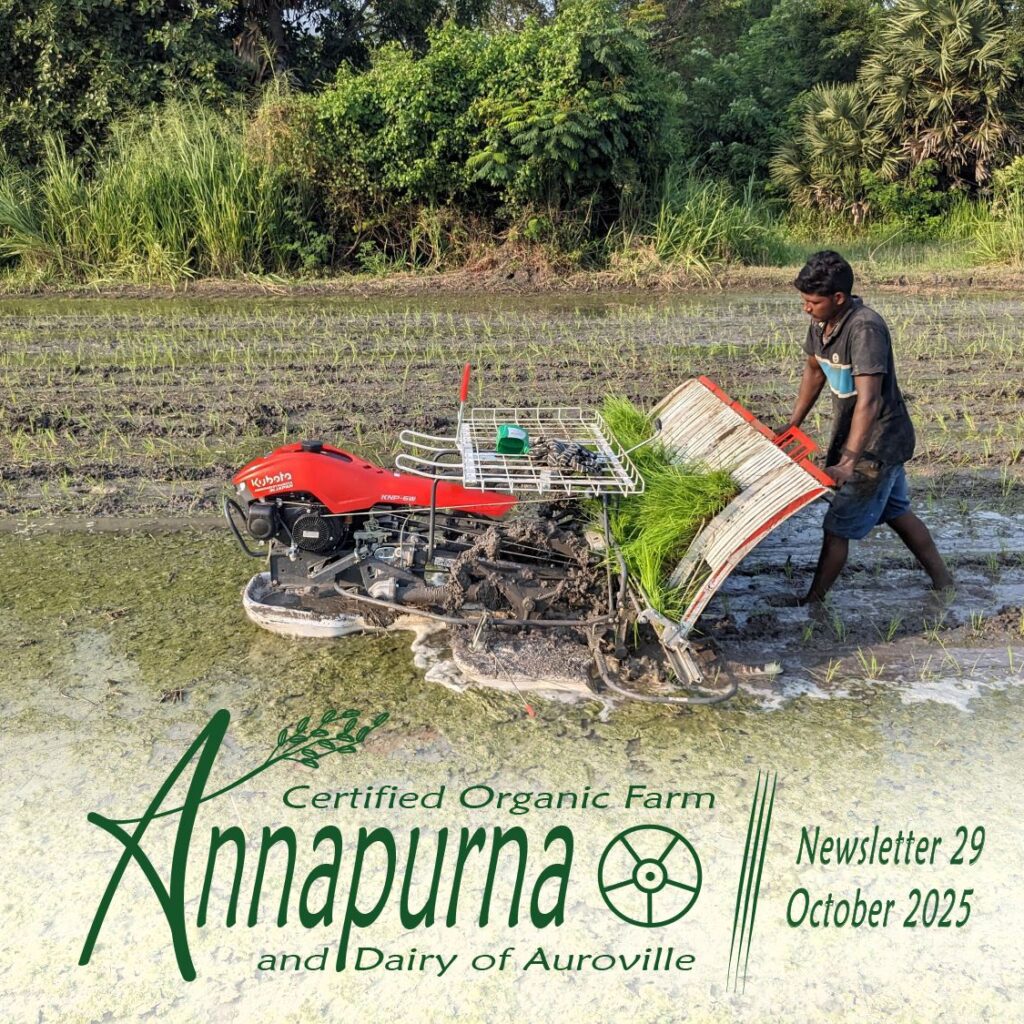
What’s going on at Annapurna Farm? When running into people in Auroville this is the most common question I get. And the answer is; “We are busy like usual with all the normal stuff; the rice planting season is on which means a lot of work.” After the initial bomb which fell on us in the middle of August, and a meeting with some of the AVFO constituted groups where some details were shared (see link), it has been quiet for some time now. We have visited one land parcel (presumably 11 acres) which was totally unsuitable because of size and proximity to the Irumbai lake and gets for a big part flooded in the monsoon. We have asked farm service to show us another location but have not heard from them since. We have sent a very rudimentary relocation plan to ATDC few weeks back but have not gotten any response as of now. It was interesting to see for us to make this plan, because we tried to imagine how a relocation plan for Annapurna farm would look like. We did realize, if they really are serious about relocating this farm, it will take a lot of land, time, planning and energy, and money to do this. As mentioned above we are actually very busy with the farm right now. Transplanting rice seedlings with a machine (see picture above) is not just that. Many things change when one introduces a new tool like this in the operation. Every year Annapurna is cultivating rice on approximately 20 acres. This is a very intense operation which needs to be coordinated well to make it work properly. The season for planting is short and needs to be completed in around 2.5 months because our traditional paddy varieties are very time bound and the monsoon is very short. We realized that using the transplanter we need more seedlings than when planting manually, fields need to be less sloshy to have proper planting results, weeds compete faster since there is a bigger time gap between field preparation and planting… and more considerations which I do not want to bother you with. But as you can imagine there is a lot of learning and adjusting because of changing one part of the cultivation. It is very interesting and it takes a lot of our attention right now. Top: the seedlings to be transplanted + Kowshik carrying the seedlings to be loaded on the transplanting machine. Bottom: paddy transplanter in action From the beginning we have decided that we do not want to get caught in the lies and slanderous allegations which are flying around Annapurna. Right now, we see some claims being sent around which have really nothing to do with our reality. Some of the allegations are: Annapurna farm has been repacking outside purchased rice and sold as Annapurna product. A most ridiculous allegation. We never repacked and sold under the Annapurna name. In fact we are under strict IMO Control one of the better organic certification bodies in India and have regular inspections to see that we are keeping to high standards and total transparency is a must. Another allegation which I just read recently is that we have been cultivating marijuana for 40 years at Annapurna. Such an allegation is so ridiculous that I even cannot really muster the energy to react on it. Someone mentioned that we have been enjoying all these acres long enough and it is time we move… There is some truth in that one, since we enjoy the work on the farm it has become what it is; the best equipped farm of Auroville. We will surely move when the right conditions are there, but the current vision does not look like the right one… All this and much more, makes one wonder under what spell Auroville is right now. The work on the farm, together with the local villagers, being in contact with the elements, the earth, plants and animals keep us grounded and positive. We are getting a lot of support from many people in and outside Auroville and that keeps us going with a purpose and the feeling that we are in it together. Top left: grain storage at the Granary – right: Velu milking Mari Bottom left: Workshop – right: Selvi and Manjula spreading out parboiled paddy for air drying
Newsletter 28 | Urgent update from the farm
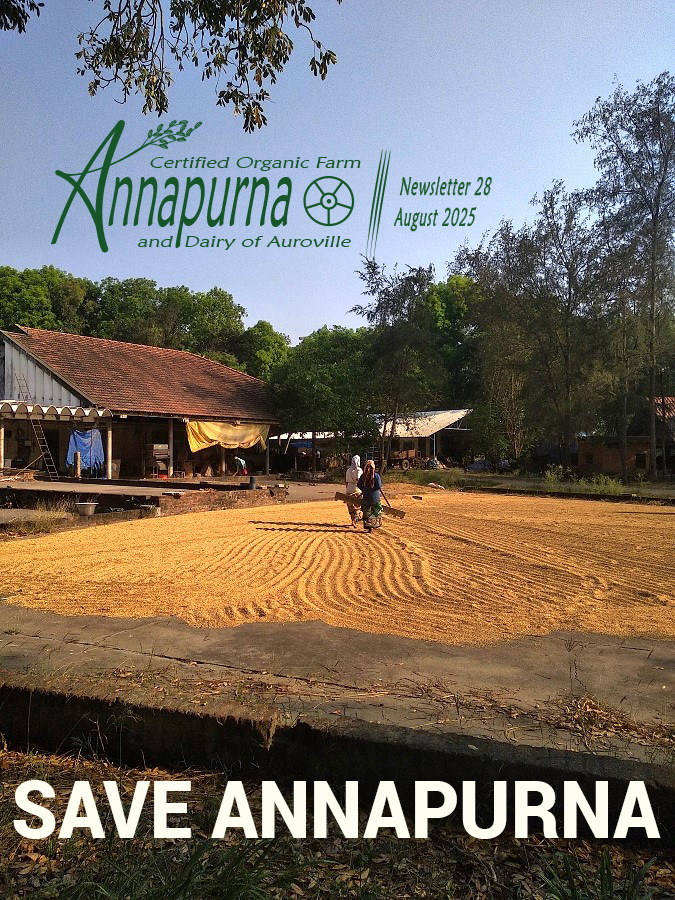
And here we are back again with a short, important update. After our last Newsletter in which I tried to describe the processes we are pushed through by our administration, this writing is to continue to describe our current reality. The cumbersome various processes of trying to get your donations released continues. This has gotten to the point that we had to report and declare about all the donations from our inception … that’s 40 years! And still … donation(s) are not released to us. All this is nothing compared to the next challenge we are now facing… Two days ago this letter flew into our inbox from the current Office of the Secretary, Auroville Foundation, and the Governing Board-backed town planning team. We are amazed how far things have gone out of hand by now. Please read it for yourself: 13 August 2025 Dear Managers of Annapurna Farm, It has been decided to allocate 100 acres of Auroville land at Annapurna for the IIT Sustainability Campus project. Consequently, Annapurna Farm will need to relocate its operations to the western portion of the land parcel, comprising approximately 34 acres. We invite you to a joint meeting with FAMC, Farm Service, and ATDC to discuss this matter and work out a transition plan for the proposed shift. Kindly confirm your presence for the meeting scheduled on 18 August 2025 at 10:00 a.m. at the Auroville Foundation Bhavan, Ground Floor Conference Room. Warm regards, FAMC, Farm Service and L’avenir d’Auroville team Even after all that has happened in Auroville in the last several years, this shocked us to the core. Without any discussion or prior intimation these decisions are made over our heads as if talking about little matters. Relocating a farm? Did any of these people really think about that? We are trying to get more info about this deal between the Auroville Foundation Office and IIT Madras. What we’ve read in the newspapers and social media is that there would be an EV (electric vehicle) truck testing track built on the land. And it’s calling itself a ‘sustainability’ project … being willing to wipe out a fully functional, established organic farm. Boggles the mind.Lots of people are very concerned about what is happening and are offering their help. This is giving us a lot of support. We are looking at how to best respond to this latest challenge. In the meantime many things are put into motion to put public pressure on decision makers to undo this move of which one is this petition. To be continued soon, Much love, Tomas
The Duck Project fundraising campaign
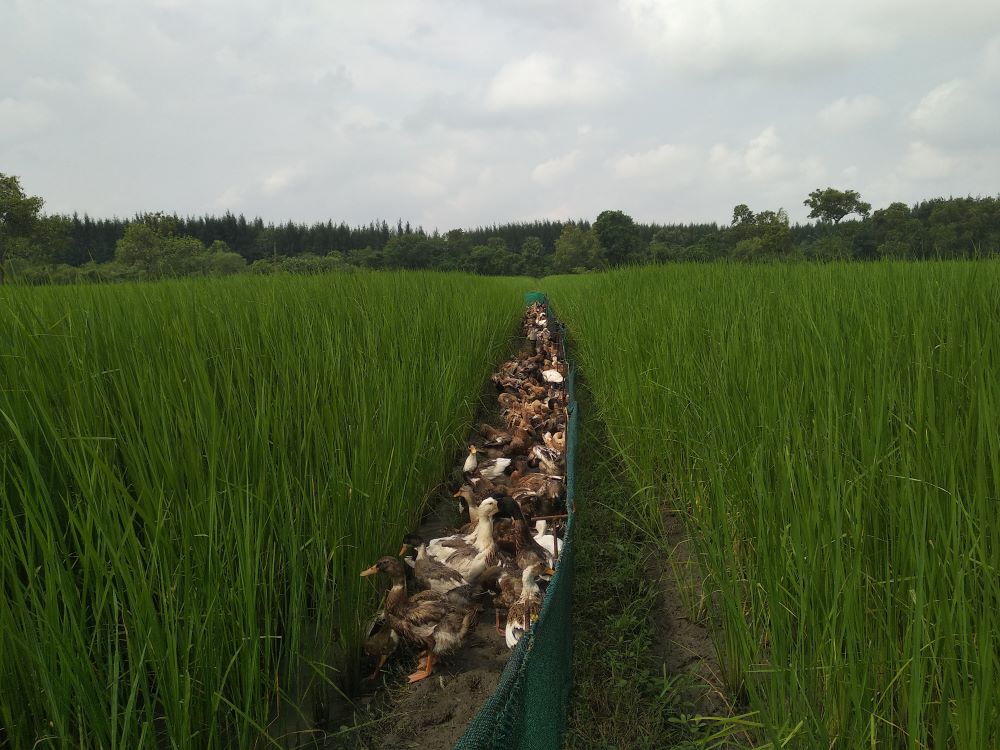
We have been thinking about ducks in the paddy crop for many years. We kept postponing it since we are already buried under a daily intense workload, and taking up something more is always an extra effort and needs a good reason to do so. There have been studies where they combine ducks (and or fish) with a rice crop in Southeast Asia with success. Ducks take care of the weeds, fertilize the field, and stimulate rice plant growth by moving around the plants throughout the day. They also control pests by eating insects, snails and what not. Last year was a very difficult paddy year when, because of various reasons, the weeds overgrew the paddy crop and we had to spend an enormous amount of labor (and money) on weeding; we lost entire plots of paddy and on a lot of fields the crop was reduced heavily. It became clear that unless we find a way to control the weeds better the crop will become unviable. This summer we have been initiating a new project to integrate ducks into rice cultivation. We purchased 53 ducks and learned a lot about growing them up and herding them around. After they were grown the Lake Estate farm of the Sri Aurobindo Ashram took them over. Now we got a new flock of 222 young birds, which have been introduced in the paddy fields this season where they control weeds very effectively and plants look healthy where they have been introduced. To take care of 6 acres paddy we would need to bring in 1200 ducks. For this we need to increase infrastructure on the farm substantially. This project has the potential to change the face of the farm; to integrate ducks to increase production and move closer to the ideal of natural integrated and healthy farming on a larger scale. With the Duck project, we are participating in theAVI USA Matching Campaign 2023.When you donate through their site this month,they will double the donated amount.Click here and double your impact this December! (For FS account holders, you can also transfer your donation directly and anytime on account #0465) Have a look at the budget calculated for the project if you would like to know the details.
A Long Summer, 2023
Ducks at AnnapurnaThis summer we have been initiating a new project to integrate ducks into rice cultivation. We purchased 53 ducks and learned a lot about growing them up and herding them around. After they were grown the Lake Estate farm of the Sri Aurobindo Ashram took them over. Now We got a new flock of 222 young birds, which will be introduced in the paddy fields in the coming season and we hope they will help reduce the labor of paddy weeding and increase rice yields. Fence Pilot 3After having done a small concept pilot (1) we worked with a contractor to put down around 120m fence (pilot 2) We have arrived at the third pilot where we mechanized most of the lifting of pillars and cuddapah slabs and hired in a few more people to build the next 80m or so last month. We are looking at the results and will continue with this project after the monsoon in January. We think the last trial will be best for us with less labor cost and better quality of fence. Irrigated area extension and installation solar pumpWe are in the process of extending our irrigated area with two more acres. This area will be mainly used for animal fodder. We are aiming to bring back the grain feed for the dairy herd and increase green fodder. This project was made possible by a donation through Waterlink.Then we installed a solar pump on one of our rainwater catchment areas and so we pump rainwater into the fields with solar power. Another step towards a more sustainable way of farming. The pump was donated by a well wisher. Annapurna Farm “Summer” CheeseWe had a usual drop in demand of produce/products in Auroville during summer. Our cows do not agree with this human behavior and keep producing milk like usual. This summer Massimo from M&M Cheese offered to trial some semi-hard cheeses to help us manage the milk flow in these low demand months. We are happy with the taste and texture of this new cheese: Annapurna Farm ‘summer’ cheese. It’s a mild cheese, semi-seasoned 60+ days; and have been exclusively available on the our CSA basket list and M&M Cheese Shop at Kuilapalayam. And Paddy begins at Annapurna,Season 2023-24
End of the Fiscal Year 2022-23
In the past few months, we have been busy harvesting paddy, including drying, cleaning and bagging the harvest. We also procured millets, paddy and pulses from Auroville as well as from bioregional organic farms. The procuring of products happens through our Foodlink Grains activity which is based at Annapurna Farm. Most farms have very limited storage capacity and no way to process the grains. For about 10 years Annapurna has been the grain basket for Auroville. We look at the needs of various dry goods in Auroville, procure where needed and possible, store, process and deliver to Foodlink in Auroville when there is demand for these products. Then there was the end of the financial year-end accounts including stock checking and updating! For 35 years Annapurna always kept accounts in an unofficial way; over the years self-developed a management account system that was based on trust and was sufficient to steer and oversee the farm. From 2022 we are asked to deliver accounts that are to the government standard and can be audited by the CAG. This was a lot of learning and asked much more time to deliver and lots of explaining to be done to the accountants about how it all works in reality on a farm.We were also confronted with new rules of the FSSAI, the food safety organization of the government, which is making it more difficult for small players like us to stay alive. Then we saw a dramatic raise in millet prices, which in itself is great, but has repercussions for the farm which are quite challenging.More about all that, and more, later.
Sesame Harvest 2023
We harvested the rain-fed sesame crop from the far-out plot [id: 373] this week. It took us 3 days to finish the harvest* from 4 acres, but we managed to harvest most of the crop in time without seed loss [shattering] due to over-ripening.*Sesame is harvested when the leaves turn yellow and start drooping and the seed capsules are green/lemon yellow by pulling out the plants. Once the bundles come to the drying floor, they are stacked and “smoked” as a traditional post-harvest pest control method and left to mature till the seed pod is ripened. After 8 days the plants are taken out of the pile and dried in the sun. During the drying process the seed capsules will open and the seeds fall out on the floor. Once all seeds are on the floor, the plant stalks are removed and the seeds are dried, cleaned and stored in plastic airtight containers and flushed with CO2 because sesame seed is easily infested by weevils and bugs during storage. Before processing or sale, seeds are washed and re-dried. Looking back over this season of rain-fed sesame crop, there was just enough rain to get the seeds germinated and plants established in the early stage and a few light rains to develop the crop. Rain-fed post monsoon crops are quite risky and it is very important that we get the right amount of rain at the right time or one can easily loose the crop when rains fail or are too heavy.As plot 373 was tilled for the first time for the cultivation since many years, we did not observe the overwhelming growth of weeds and avoided weeding altogether. We protected the field with a solar powered electric fence to keep out the pigs, deer and village cows/goats. Sesame at Annapurna is processed into ‘Gomasio’ to make the cultivation economically viable. Gomasio is a dry condiment/seasoning made using toasted sesame seeds and Himalayan salt (Classic Blend) and another with addition of pepper to the original classic blend. This is a low-sodium, nutritious, umami-rich seasoning that you can complement with a variety of foods, especially salads or simply plain rice and ghee!
Other Crops and Paddy Updates
We finished harvesting the first paddy (CO43) and the straw was put into bales. We had to rush the bales to the store because there were predictions for rain.The next variety (called Annapurna – used for complete rice) is ripening and can be harvested soon. The last variety; our red rice “Poovan samba” is coming into the heading stage in the fields and will be harvested last. As the paddy season passes; we have a sesame and mustard crop getting ready for harvest on the far out plot(id 373) which was sown in the newly planted gliricidia plantation. This crop was sown in the end of November as a post monsoon crop. These are rain fed crops and need little water only. Here’s the new tractor implement – mulcher in action, preparing a field (plot 392BB south) to sow green gram + cowpea + ragi mix under irrigated conditions. This is an experimental plot where we work in alleys between Gliricidea rows with micro sprinklers. We hope to expand this type of cultivation in the years to come.
Paddy Harvest Begins
At Annapurna, we began our new year starting with the paddy harvest. As the sequence of sowing paddy in multiple seedbeds, we have paddy starting to ripen from late December to early March.This year weather favored us with light rather than no showers close to this harvest. We hand-harvested early sown Bhavani (test field) and CO43 seed field for precision while the rest of the 3.5 acres were harvested using a track combine harvester – a smaller machine than a regular combine harvester; a bit higher on the price point but works efficiently in the wet field conditions without making deep tracks on the paddy fields.Currently harvested paddy is being sun-dried, followed by winnowing to clean and separate filled grains from empty husks. This particular seedbed was into the heading – flowering stage during rainy-cloudy days which does have negative effects on the pollination process. We will be curious to see how many bags (KG) this early sown paddy variety fills.